
Master Your Core & Upper Body: The Ultimate Stability Workout
Featured Workout Apparel: Heat Gear Armour Tank | Under Armour Speedform Gemini Running Shoes | Printed 6-Pack Headbands | Under Armour Heatgear Alpha Printed Capris
In the pursuit of a strong, functional physique, focusing on your upper body and core stability is absolutely paramount. This isn’t merely about aesthetics; it’s about cultivating a resilient body that effortlessly supports everyday movements, significantly enhances athletic performance, and acts as a powerful shield against injuries. A robust, well-conditioned core serves as the central powerhouse of your entire body, seamlessly connecting your upper and lower halves, and providing the foundational stability required for virtually every action. Simultaneously, strong, balanced upper body muscles enable efficient pushing, pulling, and lifting, crucial for both daily tasks and demanding physical activities.
When thoughtfully combined, a dedicated upper body and core stability routine can profoundly transform your fitness journey. Expect to experience dramatic improvements in posture, a heightened sense of balance, and a noticeable increase in overall strength. Get ready to embark on a challenging yet incredibly rewarding journey with this dynamic workout, meticulously designed to leave you feeling stronger, more stable, and more capable than ever before.
Why Core and Upper Body Stability Matters for Peak Performance
Many individuals in the fitness world often gravitate towards isolating muscle groups, believing this is the path to strength. However, true functional strength, the kind that translates into real-world capability, emerges from the intelligent integration of these muscle groups. Your core muscles – an extensive network encompassing everything from your abdominal muscles and obliques to your lower back, hips, and glutes – form the bedrock of nearly every movement you initiate. They are the primary architects of stability, providing the essential support needed to efficiently transfer power throughout your body and, crucially, to protect your spine from undue stress.
Similarly, a strong upper body transcends the pursuit of purely visual gains like bulging biceps. It signifies the balanced and harmonious development of your chest, back, shoulders, and arms. These muscle groups don’t operate in isolation; they work in concert to control intricate movements, maintain impeccable posture, and generate significant force. This particular workout is intelligently crafted to specifically target the synergistic relationship between these vital muscle groups. By doing so, it compels them to work in unison, thereby significantly enhancing your balance, refining your coordination, and sharpening your proprioception – your body’s intrinsic sense of its position and movement in space.
Key Benefits of a Stable & Strong Physique:
- Enhanced Athletic Performance: A supremely stable core is indispensable for generating explosive power in a myriad of sports, from the fluid motions of running and swimming to the dynamic actions of throwing and jumping.
- Superior Injury Prevention: Robust core and upper body muscles offer unparalleled support for your joints, dramatically mitigating the risk of debilitating strains, sprains, and other common musculoskeletal injuries.
- Remarkably Improved Posture: Strengthening these crucial areas actively helps to correct muscular imbalances, leading to better spinal alignment and a significant reduction in chronic back pain.
- Increased Functional Strength: Everyday activities, such as confidently lifting heavy groceries, effortlessly carrying children, or moving furniture, become considerably easier and safer to perform.
- Optimized Balance and Coordination: Exercises that deliberately challenge your stability inherently refine and improve these critical components of overall physical fitness, boosting agility and responsiveness.
The Ultimate Stability Workout Plan: Upper Body & Core Focus
This meticulously designed stability workout is a comprehensive regimen aimed at challenging your muscles, dramatically improving your balance, and forging impressive functional strength. Each exercise has been carefully selected for its ability to engage multiple muscle groups simultaneously, ensuring an incredibly efficient and profoundly effective training session. Throughout this workout, it is imperative to pay close attention to your form and to always listen intently to your body, modifying movements as and when necessary to maintain safety and efficacy.
Equipment Needed for Your Stability Session:
- Medium and heavy dumbbells (ensure you have a range to challenge yourself)
- A sturdy, flat workout bench
- Bosu ball (dome side up for most exercises)
- Physio ball (large stability ball)
- Treadmill or Elliptical (for your warm-up cardio)
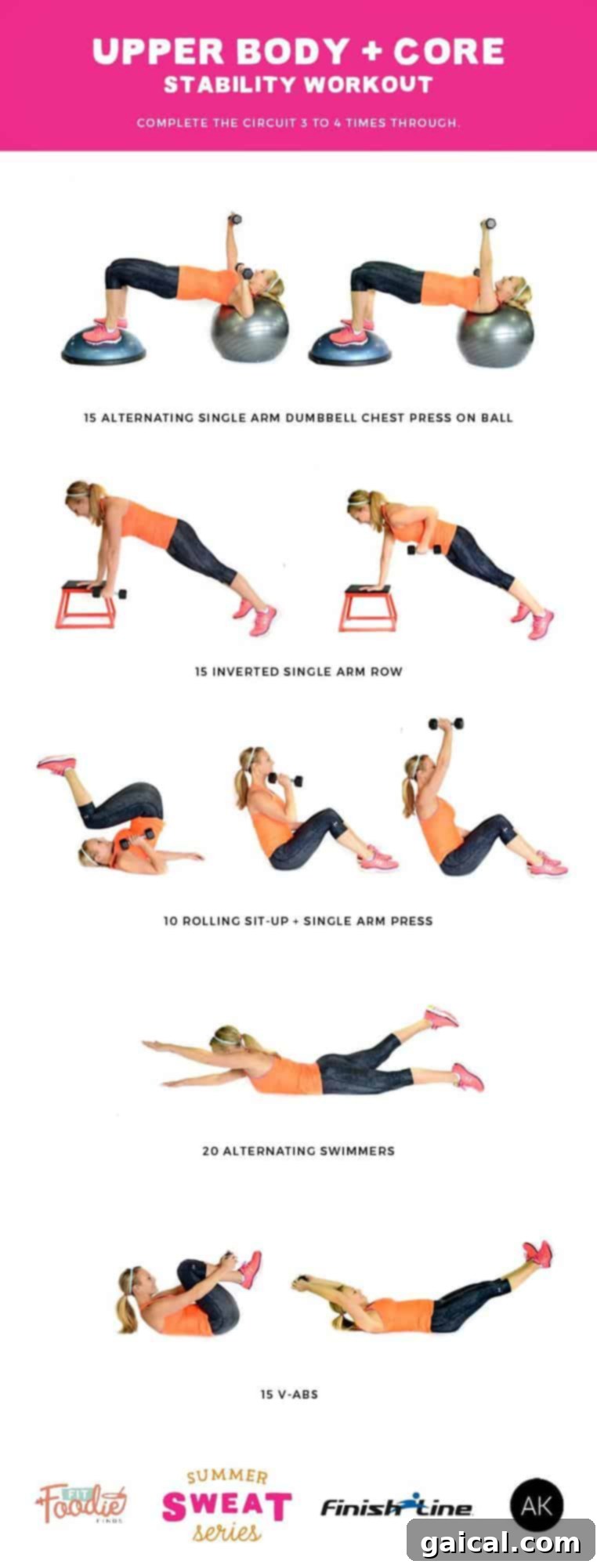
Workout Structure: To maximize the benefits of this routine, aim to complete the entire circuit 3 to 4 times through. Allow for brief, controlled rest periods between sets if absolutely necessary, but strive to keep transitions smooth. Your primary focus should be on executing controlled, deliberate movements and actively engaging your core throughout every single exercise.
Dynamic Warm-Up: Prepare Your Body for Peak Performance
Before you dive into any strenuous physical activity, a comprehensive and proper warm-up is not just beneficial, it’s absolutely essential. It serves to gradually increase blood flow to your working muscles, gently elevates your core body temperature, and meticulously prepares your joints for the demands of movement. This crucial preparatory phase significantly reduces the risk of potential injuries and simultaneously primes your body to perform at its absolute best. Under no circumstances should you skip this vital initial step!
Recommended Warm-Up Protocol:
- Cardiovascular Activation (10-15 minutes): Begin with a moderate-paced 1-mile jog on the treadmill or spend 10-15 minutes on the elliptical machine. The goal here is to gradually elevate your heart rate and get your blood circulating without prematurely fatiguing your muscles.
- Dynamic Stretches (5-7 minutes): Follow your cardio with a series of dynamic movements that prepare your muscles and joints for the upcoming strength work:
- Arm Circles: Perform both forward and backward circles, gradually increasing the range of motion.
- Torso Twists: Gently rotate your torso from side to side, keeping your hips relatively stable.
- Leg Swings: Execute forward/backward leg swings and side-to-side swings to open up the hips and hamstrings.
- Cat-Cow Stretch: Flow through these two yoga poses to mobilize your spine.
- Bodyweight Squats: Perform 10-15 controlled bodyweight squats to activate your lower body.
- Bird-Dog: Engage your core and improve stability by extending opposite arm and leg.
The Stability Workout Exercises: A Detailed Breakdown
1. Single Arm Dumbbell Chest Press on Physio Ball with Bosu Ball Feet (15 reps per side)
This challenging exercise is a phenomenal choice for developing unilateral chest strength, enhancing shoulder stability, and demanding intense core engagement. By performing the chest press on an unstable physio ball while simultaneously supporting your feet on a bosu ball, you introduce an extraordinary level of instability. This setup forces your deep core stabilizers to work tirelessly, ensuring every muscle in your midsection is firing to maintain balance.
How to Perform:
- Precision Setup: Position yourself with your upper back and the base of your neck comfortably resting on the physio ball. Your feet should be placed firmly and shoulder-width apart on the dome side of the bosu ball. Crucially, engage your glutes and hamstrings to lift your hips, forming a perfectly straight line from your knees through your hips to your shoulders. This creates a strong, stable base.
- Dumbbell Grip & Starting Position: Securely grasp a medium-weight dumbbell in each hand. Extend both arms straight up towards the ceiling, ensuring your palms face each other, with a slight, natural bend in your elbows. This is your initial, stable starting position.
- Controlled Execution (Single Arm Press): With unwavering focus, maintain an exceptionally tight core and robust glute engagement to keep your body absolutely stable and level. Slowly and deliberately lower only one dumbbell down towards your side, allowing your elbow to track outwards and form a “T” shape with your body. Feel the deep, controlled stretch across your pectoral muscle as you descend.
- Powerful Return: Once your elbow is positioned slightly below the level of the physio ball, initiate a powerful press, driving the dumbbell back up to the starting position. Concentrate intensely on contracting your chest muscle throughout this concentric phase of the movement.
- Alternation & Repetition: Briefly reset and stabilize both arms at the top (fully extended). Then, smoothly repeat the exact same movement with the other arm. Aim to complete 15 high-quality repetitions on each side, accumulating a total of 30 presses per circuit.
Mastery Tips:
- Maintain perfectly level hips throughout the entire exercise; rigorously prevent any sagging or twisting.
- Keep your gaze fixed on the ceiling to help maintain optimal neck and spinal alignment.
- Actively engage your core as if bracing for an impact or a punch, sustaining this engagement through every rep.
Adaptive Modifications:
- To Simplify: Perform the chest press on a flat, stable bench, or keep your feet firmly planted on the floor instead of the bosu ball. Opt for lighter dumbbells to reduce the load.
- To Intensify: Challenge yourself with heavier dumbbells. Dramatically slow down the eccentric (lowering) phase of the movement, or incrementally increase the total number of repetitions per set.
2. Inverted Single Arm Dumbbell Row (15 reps per side)
This dynamic and challenging exercise is truly exceptional for forging robust back strength, specifically targeting the latissimus dorsi and rhomboid muscles. Simultaneously, it presents a significant challenge to your core’s anti-rotational stability, making it a demanding yet incredibly effective full-body movement. The unique combination of an inverted plank position with a single-arm row elevates this exercise to a high level of difficulty and reward.
How to Perform:
- Precise Setup: Begin by establishing a strong, high plank position with one hand firmly and securely planted on a sturdy weight bench or an equivalently elevated, stable surface. Ensure your body forms a perfectly straight, rigid line from the crown of your head all the way down to your heels. Actively engage your core and glutes to create this solid plank. Hold a medium to heavy-sized dumbbell in your free hand, allowing it to hang directly below your shoulder with your arm fully extended.
- Core as Foundation: Brace your core muscles with unwavering intensity to rigorously prevent any rotation or unwanted movement in your hips or torso. Your entire body must remain as still and unmoving as a solid, unyielding plank throughout the exercise.
- Powerful Execution (The Row): On a deliberate exhale, initiate the movement by powerfully pulling the dumbbell upwards towards your chest. Drive your elbow high, consciously aiming to bring it level with or even slightly above your back. Concentrate specifically on squeezing your shoulder blade forcefully at the very peak of the movement, maximizing muscle contraction.
- Controlled Release: Hold the contracted position for a brief, intentional moment to ensure maximum muscle engagement and to fully feel the squeeze. Then, on a controlled inhale, slowly and smoothly lower the dumbbell back down to the starting position, meticulously maintaining tension in your core and controlling every inch of the descent.
- Seamless Repetition: Complete 15 precise repetitions on one side. Once finished, carefully and safely switch the dumbbell to your other hand and repeat for another 15 repetitions on the opposite side, ensuring symmetry and balance.
Mastery Tips:
- Maintain perfectly square hips that remain parallel to the ground throughout the entirety of the set. Vigorously resist any tendency to rock, tilt, or twist your body.
- Preserve a neutral spine; actively prevent your lower back from excessively arching or rounding at any point.
- The power for the rowing motion must originate from your back muscles, not from relying on momentum or swinging.
Adaptive Modifications:
- To Simplify: Perform the inverted row from a kneeling plank position to reduce the load, or opt for a lighter dumbbell.
- To Intensify: Challenge yourself with a heavier dumbbell, increase the isometric hold time at the very top of the row, or perform the exercise with your feet elevated on a sturdy box or step.
3. Rolling Sit-Up + Single Arm Dumbbell Press (10 reps per side)
This compound exercise is a truly exceptional fusion of dynamic core strength, fluid movement, and explosive upper body power. It meticulously challenges your abdominal muscles to expertly control the rolling motion while seamlessly incorporating a powerful pressing movement that actively engages your shoulder and chest. This makes it a comprehensive and highly effective exercise for holistic strength development.
How to Perform:
- Initial Setup: Begin seated upright on the ground with your knees comfortably bent and your feet planted flat on the floor. Grasp a medium-sized dumbbell in one hand, positioning it securely near your shoulder, as if preparing to execute an overhead press. Maintain an upright posture with your chest lifted and your back flat.
- Controlled Roll Back: Engage your core with precision and, with utmost control, slowly and smoothly roll onto your back. As you execute this roll, ensure your knees remain tucked in towards your chest and the dumbbell stays securely close to your shoulder. Crucially, avoid any abrupt “flopping” of your head; maintain complete control throughout the entire descent.
- Dynamic Roll Forward & Press: Utilizing the concentrated strength of your abdominal muscles, initiate a controlled and powerful roll forward, propelling yourself back up to the seated position. As you fluidly reach the upright seated posture, immediately transition into a single-arm overhead dumbbell press, extending the dumbbell straight up towards the ceiling with purpose and control.
- Completion of Repetition: With equal control, lower the dumbbell back down to your shoulder, consciously maintaining your upright, flat-back seated posture. This complete sequence signifies the successful execution of one full repetition.
- Symmetrical Repetition: Perform 10 high-quality repetitions on one side. Upon completion, carefully and safely switch the dumbbell to your other hand and perform another 10 repetitions on the opposite side, ensuring balanced muscle development.
Mastery Tips:
- Control is the absolute paramount factor in this exercise. Rigorously avoid using momentum to either roll up or press the dumbbell; every movement should be deliberate.
- Maintain active core engagement throughout the entire exercise duration to comprehensively protect your spine and enhance stability.
- Ensure your back remains perfectly flat in the seated position, both before and immediately after the pressing action.
Adaptive Modifications:
- To Simplify: Opt for a lighter dumbbell, or choose to perform the exercise with no weight at all. Initially, focus solely on mastering the controlled rolling sit-up motion before introducing the press.
- To Intensify: Challenge yourself with a heavier dumbbell. Alternatively, intentionally slow down both the rolling backward and rolling forward phases to significantly increase the time your muscles are under tension.
4. Alternating Swimmers (Posterior Chain Power) (20 total reps)
The Alternating Swimmer, often recognized as a beneficial variation of the “Superman” exercise, is an incredibly effective posterior chain movement. It precisely targets and strengthens your lower back, glutes, and hamstrings, while simultaneously making significant improvements to your overall core stability and body awareness. This exercise is particularly excellent for counteracting the negative effects of prolonged sitting and plays a vital role in promoting superior spinal health and posture.
How to Perform:
- Initial Setup: Lie face down comfortably on the ground. Extend your arms straight out in front of your head, mimicking a “Superman flying” posture, and extend your legs straight behind you. Maintain a neutral head position, allowing your gaze to fall naturally towards the floor, ensuring your neck is in line with your spine.
- Precise Execution (Lift): On a controlled inhale, simultaneously lift your chest and shoulders gently off the ground. At the same time, lift your right arm and your left leg. Concentrate intently on squeezing your glutes and actively engaging your lower back muscles. Keep both your lifted arm and leg straight, but consciously avoid any hyperextension at the joints.
- Brief Hold & Controlled Release: Hold the peak of the lifted position for a brief, intentional moment, deeply feeling the contraction in your back and glutes. Then, on a slow, controlled exhale, smoothly lower your right arm, left leg, and your upper body back down to the precise starting position on the floor.
- Seamless Alternation: Without pausing for rest, immediately repeat the exact same movement on the opposite side, lifting your left arm and your right leg. This completes one full, harmonious cycle of the exercise.
- Repetition Goal: Continue to alternate sides smoothly and deliberately for a total of 20 repetitions (which equates to 10 lifts on each individual side).
Mastery Tips:
- Engage your core actively and continuously to provide critical protection for your lower back; envision pulling your belly button towards your spine throughout the movement.
- Execute every movement slowly and with absolute control. Rigorously avoid any jerky motions or reliance on momentum, which can diminish effectiveness and increase risk.
- Maintain your neck in perfect alignment with your spine; resist the urge to crane your neck upwards, which can cause strain.
Adaptive Modifications:
- To Simplify: Perform the exercise by lifting one limb at a time (e.g., first lift just one arm, then just one leg) or focus solely on lifting only your upper body or only your lower body.
- To Intensify: Increase the isometric hold time at the very apex of each lift. For an advanced challenge, perform a full “Superman” by simultaneously lifting both arms and both legs at the same time, if your core strength permits without strain.
5. V-Abs (Dumbbell Resistance) (15 reps)
The V-Abs exercise stands as an advanced and highly effective core movement that dramatically challenges your entire abdominal wall. It particularly targets the rectus abdominis (the “six-pack” muscles) and the obliques, demanding profound strength and control. The strategic addition of a dumbbell significantly increases the intensity, solidifying its status as an excellent exercise for cultivating formidable core strength, impressive endurance, and enhanced stability.
How to Perform:
- Precise Starting Position: Lie completely flat on your back on the ground. Securely hold one heavy dumbbell with both hands, extending your arms straight back behind your head, keeping them just a few inches off the floor. Extend your legs straight out in front of you, also maintaining them a few inches off the floor. For an added challenge and to follow the original instruction, subtly spread your feet to form a gentle ‘V’ shape. Crucially, actively press your lower back into the floor throughout this setup.
- Explosive Execution (Crunch & Pull): On a powerful exhale, engage your core muscles with maximum intensity. Simultaneously and with controlled power, pull your knees in towards your chest while actively lifting your upper body off the ground. As you execute this crunching motion, bring the dumbbell over your knees, aiming to lightly tap or smoothly pass it above them. Ensure the entire movement is controlled and consciously originates from your powerful abdominal muscles, rather than relying on hip flexor dominance.
- Controlled Extension: On a slow, deliberate inhale, smoothly and with precise control, extend your arms and legs back out to the long, stretched-out starting position. It is paramount to keep both your arms and legs suspended just off the floor. Pay meticulous attention to keeping your lower back pressed firmly into contact with the ground for as long as possible to prevent any undesirable arching, which can indicate disengagement of the core.
- Repetition Goal: Complete 15 high-quality repetitions, prioritizing the integrity and control of each movement over sheer speed.
Mastery Tips:
- Maintain consistent pressure of your lower back against the floor throughout the entirety of the movement. If you notice significant arching, it is a clear signal to either reduce your range of motion or to choose a lighter modification.
- Coordinate your breathing: exhale forcefully as you contract (pull your knees in) and inhale deeply as you extend back out.
- Focus on a smooth, fluid, and controlled motion rather than rushing through the repetitions. Quality always triumphs over quantity.
Adaptive Modifications:
- To Simplify: Utilize a lighter dumbbell, or perform the V-Abs with no weight at all. You can also modify by bringing your knees closer to your chest without lifting your upper body as high, or by allowing your heels to lightly tap the floor between repetitions.
- To Intensify: Challenge yourself with a heavier dumbbell. For an even greater core demand, keep your legs straighter for a more traditional “V-up” motion (only attempt if your core strength allows without lower back strain), aiming to touch the dumbbell to your shins or even your toes.
Cool-Down and Flexibility: Stretch It Out for Optimal Recovery
Equally as crucial as your initial warm-up, a comprehensive cool-down sequence is indispensable for helping your body smoothly transition from the intensity of exercise back to a state of rest. This vital phase actively aids in muscle recovery, significantly reduces the likelihood of experiencing post-workout soreness (DOMS), and markedly improves your overall flexibility and dynamic range of motion. Dedicate a focused 5-10 minutes to static stretching immediately after completing your workout.
Recommended Cool-Down Stretches: Hold each stretch for a comfortable 20-30 seconds, ensuring you breathe deeply and evenly throughout each hold to encourage muscle relaxation.
- Child’s Pose: An excellent, restorative stretch for relaxing the entire back and gently opening the hips.
- Supine Spinal Twist: A gentle yet effective stretch that targets the back and the oblique muscles, promoting spinal mobility.
- Pectoral Stretch (Doorway Stretch): Position yourself in a doorway and stretch your chest muscles, releasing tension from the upper body work.
- Triceps Stretch: Reach one arm overhead, bend the elbow, and gently use your other hand to pull the elbow closer to your head, stretching the back of your upper arm.
- Figure-Four Stretch: A superb stretch for the glutes and hips, helping to alleviate tightness in the lower body.
- Hamstring Stretch: Perform either a seated forward fold, reaching for your toes, or stand with one heel elevated on a step or bench, gently leaning forward.
- Quad Stretch: Stand tall and pull one heel towards your glutes, feeling the stretch in the front of your thigh.
Maximize Your Results: Holistic Fitness Tips for Lasting Progress
Successfully completing this challenging workout is a significant and commendable step towards cultivating a stronger, more stable version of yourself. To truly maximize your progress, ensure long-term gains, and maintain a vibrant, healthy lifestyle, it’s essential to integrate these holistic fitness tips into your daily routine:
- Consistency is the Cornerstone: Aim to perform this specific workout, or a similar strength and stability routine, 2-3 times per week. Crucially, allow for adequate rest days in between sessions to facilitate muscle repair and growth.
- Nutrition Fuels Performance: Consciously fuel your body with a well-balanced diet. Prioritize lean proteins for muscle repair, complex carbohydrates for sustained energy, and healthy fats for overall cellular function and hormonal balance.
- Hydration is Non-Negotiable: Commit to drinking an abundance of water throughout your entire day. This is especially critical before, during, and immediately after your workouts to maintain optimal physiological functions and prevent dehydration.
- Prioritize Rest & Recovery: Adequate, high-quality sleep is an absolutely crucial, non-negotiable component for muscle recovery, hormonal regulation, and overall mental and physical well-being. Strive for 7-9 hours of restorative sleep each and every night.
- Listen Intently to Your Body: Develop a keen awareness and pay close attention to any signals of pain or persistent discomfort. It is perfectly acceptable, and often advisable, to modify exercises, reduce intensity, or take additional rest days when your body demands it. Pushing beyond your limits can lead to injury and hinder progress.
- Embrace Progressive Overload: As you inevitably grow stronger, consciously and gradually increase the weight of your dumbbells, incrementally add more repetitions or sets, or strategically decrease your rest times between exercises. This principle of progressive overload is fundamental for continually challenging your muscles and stimulating ongoing adaptation and growth.
Conclusion: Your Journey to Greater Stability and Strength
Embarking on a fitness journey that intelligently prioritizes both core and upper body stability is arguably one of the most rewarding and impactful commitments you can make for your long-term health, functional capacity, and overall athletic performance. This meticulously crafted workout provides a challenging yet remarkably effective blueprint to guide you in achieving exceptional strength, impeccable balance, and formidable physical resilience.
Always remember that consistency in your efforts, maintaining impeccable proper form during every repetition, and listening attentively to the signals your body sends are the unbreakable pillars upon which sustainable and meaningful progress is built. Integrate this powerful routine into your regular weekly schedule, and you will undoubtedly soon begin to experience the profound and transformative benefits of cultivating a truly stable, balanced, and undeniably powerful physique. Keep pushing your limits, continue striving for growth, and most importantly, wholeheartedly enjoy every step of this incredible fitness journey!
Disclaimer: Please consult your doctor or a qualified healthcare professional before starting any new fitness regime, especially if you have pre-existing health conditions or concerns. While Lee from Fit Foodie Finds and Monique from Ambitious Kitchen consulted with professional trainers for the Summer SWEAT Series fitness program, you are participating at your own risk. It is imperative to always modify exercises as needed and to listen intently to your body’s signals to prevent injury.
This post is sponsored by Finish Line as part of the Summer SWEAT Series. I was compensated for my contribution, and all opinions expressed herein are entirely my own and reflect my genuine experience. Thank you for your continued support of Fit Foodie Finds!