

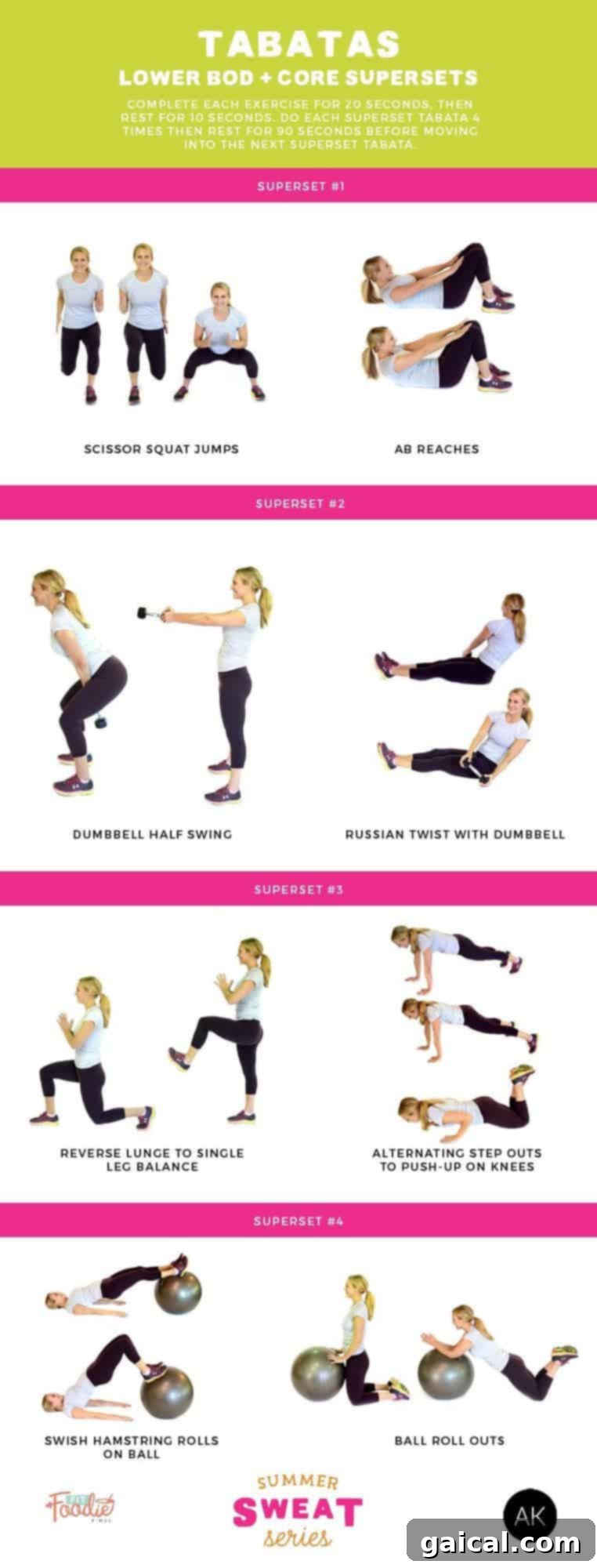
Ignite Your Metabolism: The Ultimate Lower Body & Core Tabata Workout
Are you ready to challenge your body, boost your metabolism, and sculpt a stronger physique in record time? This comprehensive Tabata workout is designed for maximum impact, blending high-intensity lower body movements with powerful core exercises. It’s perfect for anyone looking to achieve significant fitness gains without spending hours in the gym. Get ready to sweat, strengthen, and transform!
What is Tabata Training and Why Is It So Effective?
Tabata is a form of high-intensity interval training (HIIT) that follows a specific structure: 20 seconds of all-out effort, followed by 10 seconds of rest. This cycle is repeated eight times for a total of four minutes per exercise or superset. This intense, short-burst approach has been scientifically proven to significantly improve both aerobic and anaerobic fitness, leading to greater fat loss and increased muscle endurance compared to traditional cardio. The beauty of Tabata lies in its efficiency – you can achieve incredible results in a minimal amount of time, making it ideal for busy schedules.
Our workout takes the Tabata concept and applies it to dynamic supersets, combining a lower body exercise with a core-focused movement. This strategy not only maximizes calorie burn but also ensures a balanced and functional strength development across your entire powerhouse.
Equipment & Workout Structure
To get the most out of this challenging routine, you’ll need just a couple of key pieces of equipment. Ensure you have them ready before you begin!
- Heavy Dumbbell: Essential for adding resistance to your swings and twists, intensifying muscle engagement. Choose a weight that challenges you but allows for good form.
- Physio Ball (Exercise Ball): This versatile tool is fantastic for core stability, hamstring strength, and adding an element of instability to challenge your muscles further.
Workout Description:
The core of this workout revolves around supersets. For each superset, you will alternate between two exercises.
- Perform Exercise A for 20 seconds at maximum effort.
- Rest for 10 seconds.
- Perform Exercise B for 20 seconds at maximum effort.
- Rest for 10 seconds.
- Repeat this A-Rest-B-Rest cycle four times. This means you will complete 4 rounds of Exercise A and 4 rounds of Exercise B within one 4-minute Tabata superset.
- After completing all 8 intervals of a superset (4 minutes total), take a well-deserved 90-second rest before moving on to the next superset.
Each superset Tabata should take exactly 4 minutes of intense work, followed by a brief recovery. Remember to push hard during the 20-second work intervals – that’s where the magic happens!
Warm-Up: Prepare Your Body for Action
Never skip your warm-up! It’s crucial for injury prevention and optimizing your performance. A proper warm-up increases blood flow to your muscles, raises your core body temperature, and prepares your joints for movement.
Suggested Warm-Up:
- Begin with a 1-mile light jog on a treadmill or outdoors to elevate your heart rate gradually.
- Alternatively, perform a dynamic bodyweight warm-up incorporating movements like:
- Arm circles (forward and backward)
- Leg swings (front-to-back and side-to-side)
- Torso twists
- Bodyweight squats
- Lunges (forward and lateral)
- Jumping jacks (30 seconds)
Aim for 5-10 minutes of light activity to get your body ready to tackle the Tabata challenge. You can also try this dedicated warm-up routine.
Superset #1: Explosive Power & Core Stability
This superset combines plyometric lower body power with fundamental core engagement, setting an energetic tone for the rest of your workout.
1. Scissor Squat Jumps
Target Muscles: Quadriceps, Hamstrings, Glutes, Calves, Core.
How to Perform:
Begin standing with your feet hip-width apart, knees slightly bent, and core engaged.
Jump explosively upwards. As you descend, land softly with your left foot forward and your right foot back in a deep lunge position (both knees bent at approximately 90 degrees). Ensure your front knee is stacked directly over your ankle.
Immediately jump up again, switching your legs in mid-air. Land softly with your right foot forward and your left foot back in the lunge.
After completing the second lunge jump, jump one more time and land back in your starting squat position with feet hip-width apart, distributing your weight evenly into your heels.
Repeat this sequence fluidly for 20 seconds. Focus on soft landings and powerful jumps.
Modification: If jumping is too high-impact, perform alternating reverse lunges without the jump, then return to a regular bodyweight squat. Focus on controlled movements and depth.
2. Ab Reaches
Target Muscles: Rectus Abdominis, Obliques.
How to Perform:
Lie on your back with your knees bent, feet flat on the ground and hip-width apart.
Place your hands on your thighs. Lift your head and shoulders slightly off the ground, engaging your core and keeping your gaze towards your knees to protect your neck. Maintain this slight crunch throughout the exercise.
With every exhale, actively reach your hands forward, sliding them further up your thighs towards your knees, intensifying the abdominal contraction.
Inhale as you release slightly back to the starting crunch position (shoulders still off the ground). Avoid fully resting your head.
Focus on slow, controlled reaches and a strong core contraction.
Superset #2: Hip Hinge & Rotational Core Strength
This powerful duo focuses on the posterior chain with dynamic hip movements and challenges your obliques and rotational core stability.
1. Dumbbell Half Swing
Target Muscles: Glutes, Hamstrings, Lower Back, Core, Shoulders (isometrically).
How to Perform:
Stand with your feet slightly wider than hip-width apart, knees softly bent. Hold a heavy dumbbell (or kettlebell) with both hands between your legs.
Initiate the movement by hinging at your hips, pushing your glutes backward as if you’re trying to close a door with them. Allow your chest to tilt forward, keeping your back flat and core tight. The dumbbell will swing back slightly between your legs. This is a hip hinge, not a squat – your knees should have a slight bend, but the primary movement comes from your hips.
Explosively drive your hips forward, engaging your glutes and hamstrings. Use this powerful hip thrust to propel the dumbbell forward and up to approximately eye level. Keep your arms straight and relaxed; the power comes from your hips, not your shoulders.
As the dumbbell begins its descent, allow it to naturally swing back between your legs, initiating the next hip hinge.
Maintain a strong, neutral spine throughout the movement. Avoid hyperextending your back at the top of the swing.
2. Russian Twist with Dumbbell
Target Muscles: Obliques, Rectus Abdominis, Transverse Abdominis.
How to Perform:
Begin seated on the floor with your knees bent and feet flat. Lean back slightly, maintaining a straight, flat back and engaged core. You can lift your feet off the floor for a greater challenge.
Hold the dumbbell with both hands extended straight out in front of your chest.
Engage your obliques and slowly twist your torso to the right, bringing the dumbbell towards the floor beside your right hip.
Immediately reverse the motion, twisting to the left side, bringing the dumbbell towards your left hip.
Exhale with each twist and maintain a lifted chest and flat back to protect your spine. The movement should come from your torso rotation, not just your arms.
Modification: Perform without a dumbbell, focusing on full range of motion and core engagement. For an easier version, keep your feet on the floor.
Superset #3: Unilateral Strength & Plank Power
This superset challenges your balance and unilateral leg strength while testing your foundational core stability and upper body endurance.
1. Alternating Reverse Lunge to Single Leg Balance
Target Muscles: Glutes, Quadriceps, Hamstrings, Calves, Core, Stabilizer Muscles.
How to Perform:
Start standing tall with your feet hip-width apart, shoulders back, and core engaged.
Step backward with your right leg into a reverse lunge. Lower your hips until your front knee is stacked directly over your ankle and your back knee hovers just above the floor. Keep your chest lifted.
On an exhale, powerfully drive off your front (left) foot, bringing your right knee up towards your chest. Balance on your left leg for a brief moment, engaging your core for stability.
Control the movement as you gently lower your right foot back to the starting standing position.
Repeat the sequence on the other side, stepping back with your left leg and balancing on your right. Alternate sides continuously for 20 seconds.
Advancement: Hold light to medium-weight dumbbells in each hand to increase the intensity and challenge your grip strength.
2. Alternating Step Outs to Push-Up on Knees
Target Muscles: Core (Transverse Abdominis, Obliques), Chest, Shoulders, Triceps.
How to Perform:
Begin in a strong high plank position: hands directly under your shoulders, body in one long line from head to heels, core tightly engaged.
Tap your right toe out to the side, slightly wider than your hip.
Return your right toe to the starting plank position.
Immediately tap your left toe out to the side, then return it to the starting position.
After completing both step-outs, gently lower your knees to the ground, maintaining a flat back and engaged core.
Perform a modified push-up, lowering your chest towards the floor while keeping your elbows close to your body. Push back up to the kneeling plank position.
Immediately lift your knees back into a high plank and repeat the sequence.
Advancement: Perform the push-ups on your toes for a full plank push-up. Focus on controlled descents and powerful pushes.
Superset #4: Hamstring & Core Isolation with Physio Ball
This final superset uniquely targets your hamstrings and deep core muscles using the instability of the physio ball, demanding precision and control.
1. Swiss Hamstring Rolls on Ball
Target Muscles: Hamstrings, Glutes, Core, Lower Back.
How to Perform:
Lie on your back on the floor. Place your calves and heels on top of the physio ball, ensuring your legs are extended. Lift your hips off the ground so your body forms a straight line from your shoulders to your heels. Your core should be actively engaged to maintain this bridge.
On an inhale, slowly and with control, roll the physio ball towards your body by bending your knees and digging your heels into the ball. As the ball comes closer, your hips will naturally lift even higher towards the ceiling. Focus on squeezing your hamstrings and glutes.
Hold for a brief moment at the peak contraction.
On an exhale, slowly extend your legs, rolling the ball back to the starting position with straight legs and elevated hips. Maintain hip elevation throughout the entire movement.
2. Ball Roll Outs
Target Muscles: Transverse Abdominis, Rectus Abdominis, Obliques, Shoulders, Lats.
How to Perform:
Begin on your knees, with your hands placed on top of the physio ball, arms extended but not locked. Your body should form a straight line from your head to your knees, with your core tightly engaged.
Slowly roll the ball forward, extending your arms and allowing your body to move into a long, almost parallel-to-the-floor position. Maintain a straight back and prevent your hips from sagging. The movement should be controlled by your core, not just your arms.
Go as far as you can without losing form or feeling strain in your lower back.
On an exhale, powerfully engage your core and lats to pull the ball back towards your body, returning to the starting kneeling position. Focus on drawing your navel towards your spine.
Advancement: Perform roll-outs from a standing position on your toes for an even greater core challenge. This requires exceptional strength and control.
Modification: If the roll-out is too challenging, hold a high plank position on the physio ball (hands on ball) for 20 seconds, focusing on stability.
The Varsity Challenge: Take It Up a Notch!
Feeling strong and energized? If you’re up for an extreme challenge and want to maximize your results, repeat the entire circuit one more time! Completing two full rounds of all four supersets will elevate your cardiovascular endurance and muscular stamina to new heights. Listen to your body, but don’t be afraid to push your limits.
Cool-Down: The Essential Recovery Phase
After such an intense workout, a proper cool-down is just as important as the warm-up. It helps bring your heart rate down gradually, promotes muscle recovery, and improves flexibility.
Suggested Cool-Down:
- Start with 5 minutes of light cardio, such as walking or a very slow jog.
- Follow with 5-10 minutes of static stretching, holding each stretch for 20-30 seconds without bouncing. Focus on the muscle groups worked:
- Quad stretch
- Hamstring stretch (seated or standing)
- Glute stretch (figure-four stretch)
- Calf stretch
- Child’s pose for back and core relaxation
- Cobra stretch for abdominal release
Maximize Your Results: Beyond the Workout
To truly get the most out of this Tabata routine, remember that fitness is a holistic journey. Ensure you’re fueling your body with nutritious foods, staying well-hydrated throughout the day, and prioritizing adequate sleep for muscle repair and recovery. Consistency is key – aim to incorporate high-intensity workouts like this into your routine 2-3 times a week, allowing for rest days in between.
This Tabata workout is more than just a quick sweat session; it’s a testament to what you can achieve with focus and intensity. You’ll not only build a stronger lower body and core but also improve your cardiovascular health and overall endurance. Get ready to feel the burn and embrace the incredible results!
Disclaimer: Please consult your doctor before starting any new fitness regime. While the creators of this workout consulted with professional trainers, you are participating at your own risk. It is crucial to listen to your body, perform exercises with proper form, and modify as needed to prevent injury. Your health and safety are paramount.