

Ignite Your Metabolism: The Ultimate Full-Body Fat Burning Tabata Superset Workout
Ready to supercharge your fitness journey and torch fat in record time? Look no further! This comprehensive full-body Tabata superset workout is meticulously designed to get your heart pumping, muscles working, and sweat flowing, all while being incredibly efficient. Say goodbye to long, drawn-out gym sessions and hello to a high-intensity, metabolism-boosting routine that delivers remarkable results.
Whether you’re short on time or simply seeking an exhilarating challenge, this workout combines the best of high-intensity interval training (HIIT) with strategic supersets to maximize your calorie burn and build functional strength. Prepare to be amazed at how quickly you’ll feel stronger, fitter, and more energized!
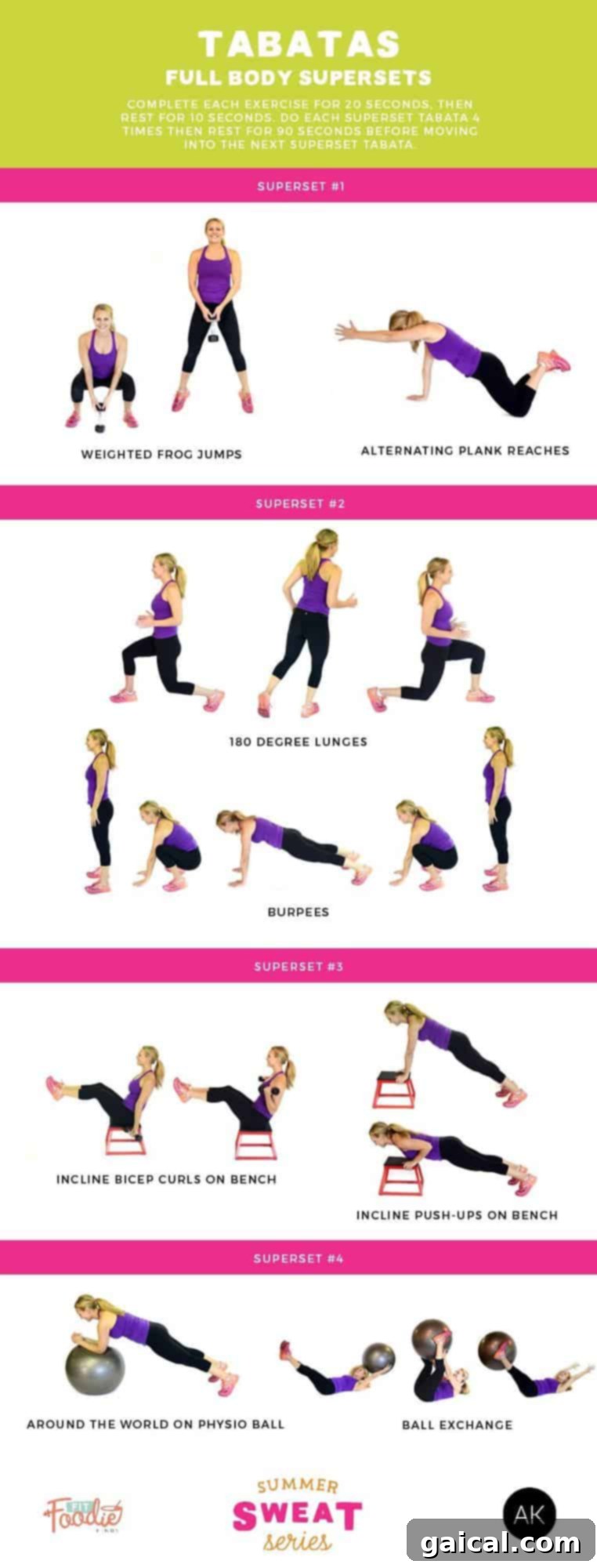
Why Tabata Supersets are Your Fat-Burning Secret Weapon
Before diving into the exercises, let’s understand the science behind this powerful workout structure. We’re combining two incredibly effective training methods: Tabata and Supersets.
The Power of Tabata Intervals
Tabata training is a form of high-intensity interval training (HIIT) that follows a specific protocol: 20 seconds of intense exercise followed by 10 seconds of rest, repeated for 8 rounds, totaling 4 minutes. Developed by Japanese scientist Dr. Izumi Tabata, this method is renowned for its ability to significantly boost cardiovascular fitness and metabolic rate. The short bursts of extreme effort followed by brief rests create an “afterburn effect,” meaning your body continues to burn calories at an elevated rate long after your workout is over. This phenomenon, known as EPOC (Excess Post-exercise Oxygen Consumption), is key to effective fat loss.
Maximizing Efficiency with Supersets
Supersets involve performing two exercises back-to-back with minimal or no rest in between. This technique keeps your heart rate elevated, increases the overall intensity of your workout, and allows you to accomplish more work in less time. By targeting different muscle groups consecutively (e.g., an upper body exercise followed by a lower body exercise) or working opposing muscle groups, supersets enhance muscle fatigue, promote greater strength gains, and significantly amplify calorie expenditure.
The Synergy: Tabata Supersets
When you combine Tabata with supersets, you create a metabolic powerhouse. Each superset in this workout will follow the Tabata protocol, meaning you’ll alternate between two exercises, performing each for 20 seconds of work followed by 10 seconds of rest, for a total of 8 rounds (4 rounds per exercise) making each superset last exactly 4 minutes. This relentless pace ensures maximum engagement of your muscles and cardiovascular system, making every second count towards your fat-burning goals.
Workout Overview: What You Need & How to Do It
This full-body workout is designed to be challenging yet accessible, perfect for home or gym settings. Ensure you perform a proper warm-up (5-10 minutes of light cardio and dynamic stretches) before starting and a cool-down (5-10 minutes of static stretches) afterward to prevent injury and aid recovery.
Equipment Needed: Medium-size dumbbells, a sturdy bench (or a robust chair/step), and a physio ball (also known as a stability ball).
Workout Structure:
- Exercise Duration: Complete each exercise for 20 seconds of intense work.
- Rest Interval: Follow each 20-second work period with 10 seconds of rest.
- Superset Repetition: Each superset consists of two exercises. You will alternate between these two exercises, completing 4 rounds of each for a total of 8 rounds per superset.
- Superset Length: Each full superset (8 rounds of 20s work / 10s rest) will last exactly 4 minutes.
- Between Supersets Rest: After completing all 8 rounds of a superset, take a well-deserved 90-second rest before moving on to the next superset.
Ready to unleash your inner athlete? Let’s get started!
Superset #1: Lower Body Power & Core Stability
This superset kicks off your workout by targeting powerful lower body muscles and engaging your core for stability and strength.
Weighted Frog Jumps
Description: Begin by holding a medium-sized dumbbell vertically between your legs (or opt for bodyweight if modifying). Stand with your feet slightly wider than hip-width apart, heels pointing slightly in, and toes angled out. Lower your hips down into a deep frog squat, ensuring your chest stays up and your weight is primarily in your heels. From this deep squat position, powerfully explode off your feet, jumping vertically into the air. Land softly and quietly back into the deep frog squat, absorbing the impact through your legs. Immediately repeat the movement.
Why it’s effective: This plyometric exercise is phenomenal for building explosive power in your glutes, quads, and calves. The deep squat ensures maximum muscle recruitment, while the jump elevates your heart rate for a significant cardiovascular challenge. It’s a fantastic fat burner that sculpts your lower body.
Modification: If weighted jumps are too intense or if you’re new to plyometrics, perform the exercise using only your bodyweight. Focus on getting a deep squat and controlled landing. Alternatively, you can perform deep frog squats without the jump, focusing on speed and range of motion.
Common Mistakes: Rounding your back, not going deep enough in the squat, or landing heavily. Focus on a flat back, full range of motion, and soft landings to protect your joints.
Alternating Plank Reaches
Description: Start in a high plank position, with your hands directly under your shoulders and your body forming a straight line from head to heels (or knees for modification). Ensure your core is tightly engaged, and your shoulders are stacked precisely over your wrists. Without allowing your hips to rotate or sag, slowly lift one arm off the ground and reach it forward, extending it in line with your body. Focus on keeping your hips parallel to the ground throughout the movement. Gently return your hand to the starting position and then alternate to the other side, maintaining complete control and core stability.
Why it’s effective: This exercise is a dynamic core stabilizer, challenging your anti-rotational strength and shoulder stability. It engages your entire core – including your obliques, rectus abdominis, and transverse abdominis – as it works to prevent your body from twisting. It also strengthens your shoulders and improves overall body control.
Modification: If a high plank is too challenging, perform the exercise from your knees. Alternatively, you can widen your feet in the plank position to provide a more stable base, making it easier to maintain balance while reaching.
Common Mistakes: Letting your hips sag or rotate significantly, rushing the movement, or not keeping your core engaged. Focus on slow, controlled movements and maintaining a rigid body line.
Superset #2: Dynamic Lunges & Full-Body Burpee Blast
Prepare for a cardiovascular and strength challenge with this superset, combining multi-directional lunges with the ultimate full-body conditioning move: the burpee.
180 Degree Lunges
Description: Begin standing tall with your feet hip-width distance apart, hands on your hips or clasped at your chest. Initiate the movement by turning your body 90 degrees to your left. As you turn, step forward with your left leg and perform a deep 90/90 lunge (front knee bent at 90 degrees, back knee hovering just above the ground). Push off your left foot to return to the center standing position, rotating back to face forward. Immediately turn 90 degrees to your right, stepping forward with your right leg to perform a 90/90 lunge on that side. Continue to alternate sides with fluid, controlled transitions, focusing on balance and depth in each lunge.
Why it’s effective: This dynamic exercise builds incredible lower body strength, improves agility, and challenges your balance. By moving in a rotational pattern, it engages different muscle fibers in your glutes, quads, and hamstrings compared to traditional forward or reverse lunges, enhancing overall athletic performance and calorie burn.
Modification: If the 180-degree turn is too much for balance, simply perform alternating forward lunges, focusing on controlled movement and deep squats. You can also hold onto a wall or sturdy object for balance assistance initially.
Common Mistakes: Losing balance during the rotation, allowing the front knee to extend past the toes, or not achieving a full 90/90 lunge position. Focus on core engagement and controlled stepping.
Burpees
Description: Stand with your feet hip-width distance apart, ready for action. In one fluid motion, bend down and plant your hands firmly on the ground, just outside your feet. Quickly jump your feet back into a high plank position, ensuring your body forms a straight line. From the plank, immediately jump your feet forward, landing them back near your hands in a squat position. Explosively push off the ground, jumping straight up into the air with your arms reaching overhead. Land softly back in the starting position and seamlessly move into the next repetition.
Why it’s effective: The burpee is the ultimate full-body exercise and a cardiovascular beast. It works almost every major muscle group – chest, shoulders, triceps, quads, glutes, hamstrings, and core – while simultaneously skyrocketing your heart rate. It’s a phenomenal calorie burner and a true test of endurance, essential for any fat-burning regimen.
Modification: To reduce intensity, step your feet back one at a time into the plank position instead of jumping. You can also omit the jump at the end, simply standing up from the squat. For an added challenge, include a push-up while in the plank position before jumping your feet forward.
Common Mistakes: Rounding your back when planting hands, letting hips sag in plank, or not getting enough air on the jump. Maintain core engagement throughout for a safe and effective burpee.
Superset #3: Upper Body Strength & Core Control
This superset focuses on sculpting your upper body, particularly your biceps and chest, while maintaining a strong core foundation.
Incline Bicep Curls on Bench
Description: Grab a pair of medium-sized dumbbells and sit on a sturdy bench (or even the floor), leaning back slightly to engage your core. Extend your legs forward in a “V” shape or straight out in front of you, similar to a boat pose, using your core for stability. With a dumbbell in each hand, palms facing forward, keep your elbows “glued” to your sides. On an inhale, slowly curl the dumbbells up towards your shoulders, contracting your biceps. Exhale as you control the movement, slowly lowering the weights all the way back down until your arms are fully extended. Focus on isolating your biceps throughout the movement.
Why it’s effective: Performing bicep curls on an incline increases the range of motion and puts continuous tension on the bicep muscles, leading to greater muscle activation and growth. The slight lean backward also forces your core to engage to maintain stability, turning this into a more comprehensive upper body and core exercise.
Modification: If a bench isn’t available, perform standard standing bicep curls, ensuring good form. If core engagement is an issue, sit upright on the bench or use a wall for back support.
Common Mistakes: Swinging the weights using momentum, not fully extending the arms at the bottom, or letting the elbows move away from the body. Focus on slow, controlled movements and a strong bicep contraction.
Incline Push-Ups on Bench
Description: Position your hands shoulder-width apart on the edge of a sturdy bench or elevated surface. Step your feet back until your body forms a straight line from head to heels, entering a high plank position. Ensure your core is tight and your gaze is slightly forward. On an inhale, slowly lower your chest towards the bench, leading with your chest and keeping your elbows tucked slightly towards your body. Maintain a flat back and engaged core throughout the descent. On the exhale, powerfully push back up to the starting plank position, fully extending your arms.
Why it’s effective: Incline push-ups are an excellent way to build upper body strength, targeting your chest, shoulders, and triceps, especially if traditional floor push-ups are challenging. The incline reduces the resistance, allowing for proper form development and gradual progression to more difficult variations. It’s a fundamental strength builder crucial for a balanced full-body workout.
Modification: If this is too easy, lower the height of the bench or move to the floor for standard push-ups on your toes or knees. If it’s too difficult, use an even higher surface or perform push-ups against a wall.
Common Mistakes: Sagging hips, arching the back, or letting the elbows flare out too wide. Maintain a straight body line and controlled movement.
Superset #4: Advanced Core & Full Body Coordination
This final superset takes your core strength and body control to the next level, incorporating dynamic movements with a physio ball for an ultimate challenge.
Around the World on Physio Ball
Description: Begin in a forearm plank position, but instead of your forearms being on the floor, place them securely on top of a physio ball. Extend your legs back, forming a straight line from your head to your heels. Ensure your core is intensely engaged, keeping your hips stable and parallel to the ground. Slowly and deliberately, use your forearms to guide the physio ball in a circular motion underneath you. Move the ball in one direction for 20 seconds, then switch directions for the next round of this exercise within the superset. Focus on keeping your body as still as possible, letting your core do the work to control the ball’s movement.
Why it’s effective: This is an advanced core exercise that demands incredible stability and control from your entire trunk. It targets not only your rectus abdominis but also your obliques and deeper stabilizing muscles. The instability of the physio ball forces your core to work overtime to maintain balance, significantly enhancing functional strength and anti-rotational capabilities.
Modification: If a forearm plank on a physio ball is too difficult, start with a standard forearm plank on the floor. For an intermediate step, try holding a standard forearm plank on the ball without the circular movement, focusing on static hold.
Common Mistakes: Allowing your hips to sag, arching your back, or letting your body sway excessively. Keep your core tight and movements controlled and deliberate.
Ball Exchange
Description: Lie on your back on the floor, extending your legs out long and your arms stretched out behind your head, holding a physio ball firmly between your hands. Engage your core as you simultaneously lift your legs and upper body off the ground. Bring your legs towards your chest and your arms towards your feet, exchanging the physio ball from your hands to your ankles. Secure the ball between your ankles. Then, slowly lower your legs and arms back down to the starting extended position, keeping the ball held by your ankles. Repeat the movement, this time exchanging the ball back from your ankles to your hands, and continue to alternate. Focus on smooth, controlled transfers and core engagement.
Why it’s effective: This full-body coordination exercise is a dynamic powerhouse for your core, particularly targeting your lower and upper abdominal muscles. It also challenges your flexibility, coordination, and strength in both your upper and lower body as you control the movement and the ball exchange. It’s a fantastic way to finish your workout with a comprehensive core challenge.
Modification: If the physio ball is too challenging, perform a “V-up” without the ball, bringing hands to feet. For an easier modification, perform alternating leg raises and crunches, breaking the movement into two separate parts.
Common Mistakes: Arching your lower back off the ground excessively, using momentum instead of core strength, or dropping the ball during the exchange. Keep your lower back pressed into the floor as much as possible and engage your core throughout.
Varsity Challenge: Push Your Limits!
Feeling energized and ready for more? For those seeking an extra challenge and to truly maximize their fat-burning potential, complete this entire circuit one more time! Performing two full rounds of all four supersets will significantly increase your total workout volume and keep that metabolism revving. Listen to your body, but if you have the energy, go for it!
Maximizing Your Results: Beyond the Workout
While this Tabata superset workout is incredibly effective, remember that fitness is a holistic journey. To truly maximize your fat-burning and strength-building results, integrate these practices into your daily routine:
- Nutrition is Key: Fuel your body with a balanced diet rich in lean protein, complex carbohydrates, and healthy fats. Hydration is equally important, so drink plenty of water throughout the day.
- Consistency Over Intensity (Mostly): Aim for regular workouts. Showing up consistently, even for shorter sessions, yields better long-term results than sporadic, ultra-intense efforts.
- Prioritize Recovery: Adequate sleep (7-9 hours per night) is crucial for muscle repair and growth. Incorporate light stretching or foam rolling on rest days to improve flexibility and reduce muscle soreness.
- Listen to Your Body: Some days you’ll feel stronger than others. It’s okay to modify exercises or reduce intensity when needed. Pushing through pain can lead to injury, so always prioritize proper form and your body’s signals.
Important Disclaimer: Your Health and Safety Come First
Please consult your doctor or a qualified healthcare professional before beginning any new fitness regime, especially if you have pre-existing health conditions, injuries, or concerns. While the creators of this workout, Lee from Fit Foodie Finds and Monique from Ambitious Kitchen, consulted with professional trainers for the Summer SWEAT Series fitness program, you are participating at your own risk.
It is crucial to listen to your body throughout this workout. If you experience any pain, discomfort, dizziness, or unusual symptoms, stop immediately. Modifications are provided for a reason – use them as needed to ensure your safety and maintain proper form. This content is for informational purposes only and is not a substitute for professional medical advice, diagnosis, or treatment. Your personal safety and well-being are paramount.
Conclusion: Embrace the Sweat, Achieve Your Goals!
Congratulations on taking the first step towards a stronger, healthier you! This full-body fat-burning Tabata superset workout is a testament to what you can achieve with dedication and smart training. By combining high-intensity intervals with strategic exercise pairing, you’re not just working out – you’re optimizing your body’s potential for fat loss and muscle gain.
Embrace the challenge, push your limits, and enjoy the incredible feeling of accomplishment that comes with each drop of sweat. Get ready to transform your body and elevate your fitness with this powerful and efficient routine. You’ve got this!