
Combine cardio and strength training for the ultimate full body workout that will tone your muscles and burn fat, leaving you dripping with sweat and feeling accomplished! This dynamic circuit is designed to elevate your heart rate, build lean muscle, and boost your metabolism, making it perfect for anyone looking to maximize their fitness results in less time.
The Ultimate Full-Body Cardio & Strength Workout: Sculpt, Tone & Burn Fat
Are you ready to transform your body, boost your energy, and achieve new levels of fitness? This comprehensive full-body workout is expertly crafted to fuse the power of cardiovascular endurance with the muscle-building benefits of strength training. Forget long, separate sessions; this circuit is your one-stop solution for burning calories, building strength, and enhancing your overall athletic performance. Prepare to challenge every major muscle group while simultaneously pushing your cardiovascular limits.
Why Combine Cardio and Strength Training?
Integrating both cardio and strength training into a single workout offers a myriad of benefits that go beyond what either discipline can achieve on its own. This synergistic approach is not just a trend; it’s a highly effective method for optimizing your health and fitness.
The Synergy of Cardio and Strength
When you combine these two pillars of fitness, you create a powerful synergy. Strength training builds muscle mass, which in turn increases your basal metabolic rate, meaning you burn more calories even at rest. Cardio, especially high-intensity interval training (HIIT) components, improves your heart health, stamina, and directly contributes to calorie expenditure during the workout.
Accelerated Fat Loss
One of the most compelling reasons to combine these training modalities is their combined impact on fat loss. Strength training helps preserve and build muscle, which is metabolically active tissue. The cardio component then acts as a direct fat-burning engine, especially when performed in an interval style within a circuit. This dual approach ensures you’re not just losing weight, but specifically targeting fat while enhancing muscle definition.
Enhanced Muscle Tone and Definition
This workout is specifically designed to hit major muscle groups, promoting muscle growth and definition. From your legs and glutes to your core and upper body, each exercise is chosen to sculpt and strengthen, giving you a lean, toned physique. The resistance work helps shape your body in ways cardio alone cannot.
Improved Cardiovascular Health and Stamina
The cardio intervals are strategically placed to keep your heart rate elevated throughout the circuit, significantly improving your cardiovascular endurance. A stronger heart means better circulation, increased stamina, and a reduced risk of various health issues. You’ll find everyday tasks becoming easier, and your overall energy levels soaring.
Boosted Metabolism and EPOC
The intense nature of this circuit, especially with its blend of resistance and quick cardio bursts, triggers a phenomenon known as EPOC (Excess Post-exercise Oxygen Consumption), or the “afterburn effect.” This means your body continues to burn calories at an elevated rate for hours after your workout is complete, helping you maximize your results long after you’ve left the gym or finished your home session.
Time Efficiency
In our busy lives, finding time for separate cardio and strength sessions can be challenging. This workout offers an incredibly efficient solution, allowing you to reap the benefits of both in a single, well-structured session. You’ll get a comprehensive, full-body challenge without spending hours at the gym.
Your Ultimate Full-Body Workout Circuit
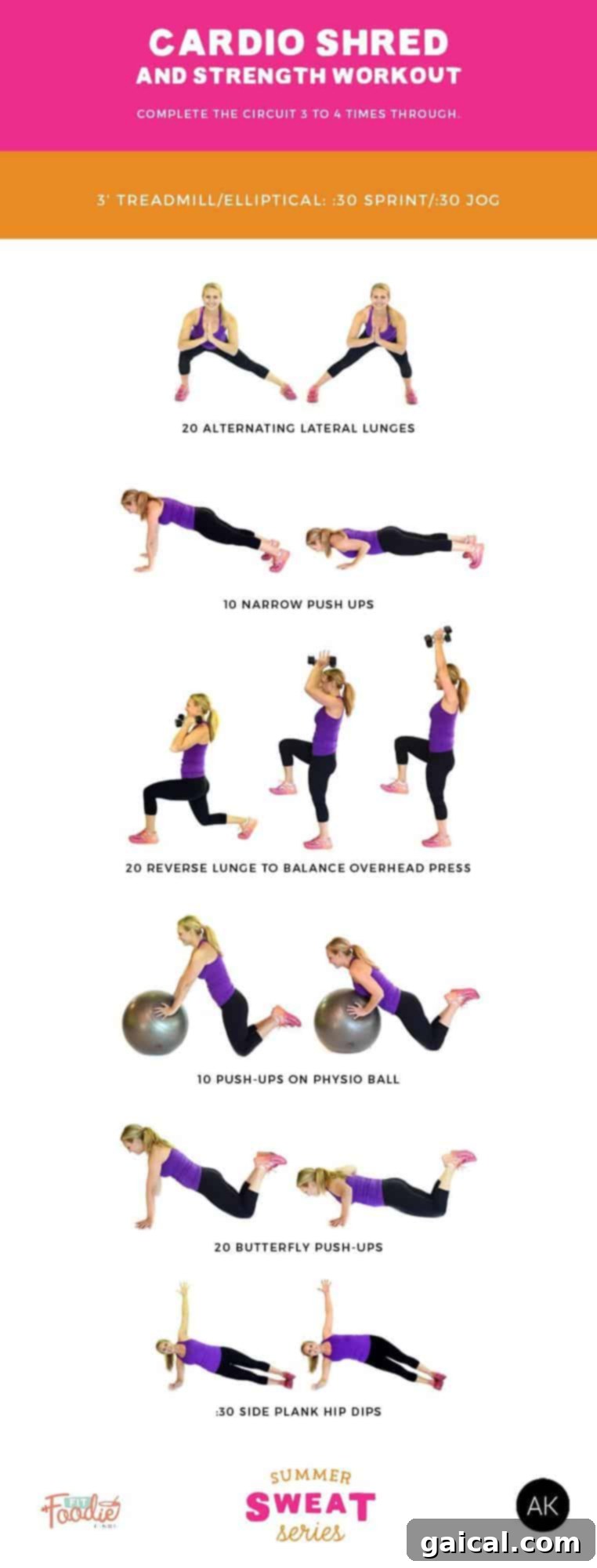
This workout is structured as a circuit, meaning you’ll move from one exercise to the next with minimal rest. Once you’ve completed all exercises in the circuit, you’ll take a short break before repeating the entire sequence. The goal is to complete the entire circuit 3 to 4 times through, depending on your fitness level and available time. Focus on proper form over speed, especially as you learn the movements.
Equipment You’ll Need:
- Medium-size dumbbells: Choose a weight that challenges you but allows you to maintain good form for all reps.
- Physio ball (stability ball): Essential for specific core and upper body exercises.
- Treadmill or Elliptical (optional, for warm-up/cardio intervals): A track or outdoor space can also work.
Preparing for Your Workout: The Warm-Up
A proper warm-up is crucial for preparing your body for the demands of this intense workout. It increases blood flow to your muscles, improves flexibility, and gradually elevates your heart rate, reducing the risk of injury and enhancing your performance. Do not skip this vital step!
Begin with a light, 1-mile jog on the treadmill (or outside) or 10 minutes easy on the elliptical to get your heart rate up. Follow this with 5 minutes of dynamic stretches to activate your muscles and joints.
Dynamic Warm-Up Drills (Perform 10-15 reps of each):
- Arm Circles: Forward and backward.
- Leg Swings: Forward and sideways.
- Torso Twists: Gentle rotations to warm up the core.
- Bodyweight Squats: Focus on depth and form.
- Walking Lunges: Open up the hips and activate the glutes.
The High-Intensity Cardio Burst
Following your warm-up, we’ll kick things into high gear with a short but powerful cardio interval. This segment is designed to spike your heart rate, get your blood pumping, and ignite your metabolism for the strength work ahead. High-intensity interval training (HIIT) is incredibly effective for cardiovascular health and fat burning.
3’ Treadmill/Elliptical Interval Breakdown:
:30 Sprint / :30 Jog (Repeat 3 times)
- :30 Sprint: Push your pace to a challenging sprint. You should be breathing heavily and feeling a significant effort.
- :30 Jog: Recover with a light jog or brisk walk, catching your breath before the next sprint.
This 3-minute cycle will repeat three times, totaling 3 minutes of focused, heart-pumping cardio.
The Strength & Toning Circuit
Now, let’s dive into the main strength portion of the workout. Remember to focus on controlled movements and engage your core throughout each exercise. Complete the specified reps for each exercise before moving to the next. Once all exercises are done, that counts as one round of the circuit.
-
20 Alternating Lateral Lunges
How to Perform:
- Begin with your feet hip-width distance apart, standing tall with your chest lifted.
- Step your right leg out to the side, lowering down into a lunge. Keep your left leg straight (like an anchor) and ensure all of your weight is in your right heel.
- Sit back into your hips, making sure your right knee stacks directly over your ankle. Your chest should remain lifted, and your back straight.
- On the exhale, powerfully push off your right heel to reset back to standing, bringing your feet hip-width distance apart.
- Alternate sides, performing 10 lunges on each leg for a total of 20 repetitions.
Muscles Worked & Benefits:
- Primarily targets the glutes (maximus and medius), quadriceps, and hamstrings, with significant engagement of the inner thighs (adductors) due to the lateral movement.
- Enhances hip mobility, strengthens the stabilizing muscles around the knee, and improves balance and functional movement for everyday activities.
Modifications & Advancements:
- Modification: Perform without dumbbells, focusing purely on form and depth.
- Advancement: Hold light or medium-weight dumbbells at your chest or by your sides for added resistance.
-
10 Narrow Push-Ups
How to Perform:
- Begin in a high-plank pose, hands directly under your shoulders, fingers pointing forward.
- On the inhale, lower down into a narrow (chaturanga) push-up, keeping your elbows tucked close to your sides and pointing directly backward.
- Lead with your chest as you lower, maintaining a flat back and a neutral neck. Your body should move as one rigid unit.
- Press powerfully back up to the high-plank position on the exhale, engaging your chest and triceps.
Muscles Worked & Benefits:
- Intensely targets the triceps, inner chest (sternal head of pectoralis major), and anterior deltoids, while also engaging the core for stability.
- Builds upper body pushing strength, particularly in the triceps, which are often underdeveloped.
Modifications & Advancements:
- Modification: Drop down to your knees to reduce the load, ensuring your body forms a straight line from head to knees.
- Advancement: Elevate your feet on a stable surface (e.g., a bench or low box) to increase the challenge.
-
20 Reverse Lunge to Balance Overhead Press
How to Perform:
- Begin standing with your feet hip-width distance apart, holding medium-size dumbbells at shoulder height, palms facing forward.
- Step back with your right leg and lower down into a 90/90 lunge (front and back knees at 90-degree angles). Keep your front knee over your ankle and your chest lifted.
- From the lunge, push off your back foot, driving your right knee forward and up into your chest, balancing on your left leg.
- As you reach the balance point, simultaneously perform a shoulder press, extending the dumbbells directly overhead until your arms are fully extended.
- Control the weights back down to shoulder height as you step your right leg back into the reverse lunge.
- Perform 10 repetitions on one leg before switching to the other side for a total of 20 repetitions.
Muscles Worked & Benefits:
- A powerful compound exercise targeting the quadriceps, hamstrings, glutes, shoulders (deltoids), and triceps, with significant core engagement for balance.
- Improves lower body strength, unilateral balance, core stability, and upper body pushing power, mimicking real-life movements.
Modifications & Advancements:
- Modification: Use light or no weights for the overhead press, or perform the lunge and press separately. You can also tap your foot down between the lunge and the balance phase if needed.
- Advancement: Use heavier weights or hold the balance for a count at the top before pressing.
-
10 Push-Ups on Physio Ball
How to Perform:
- Begin in a high plank pose with your hands placed on the outside of a physio ball. The wider your hands are placed, the more stability you’ll have, making it slightly easier.
- Ensure your body forms a straight line from head to heels, engaging your core tightly to prevent your hips from sagging or rising.
- On the inhale, lower down into a push-up, maintaining control and stability on the unstable surface of the ball.
- On the exhale, press powerfully back up into the high plank, stabilizing your body throughout the movement.
Muscles Worked & Benefits:
- Engages the chest, shoulders, and triceps, but places a much higher demand on core stability and proprioception due to the unstable surface.
- Significantly improves core strength, balance, and activation of smaller stabilizing muscles that are often neglected in standard push-ups.
Modifications & Advancements:
- Modification: Perform normal push-ups on your knees or toes with no physio ball if stability is too challenging. Alternatively, use a wider hand placement on the ball to increase stability.
- Advancement: Move your hands closer together on the ball to decrease stability and increase the challenge.
-
20 Butterfly Push-Ups
How to Perform:
- Begin in a wide-arm high plank pose. Position your hands about the width of a yoga mat, with your fingers pointing outwards and your wrists pointing slightly inward.
- Ensure your body is in a straight line from head to heels, engaging your core.
- Lower down into a push-up, leading with your chest. Your elbows will flare out to the sides. Keep your back and neck flat throughout the movement.
- Press back up to the starting wide-arm plank position, powerfully engaging your chest muscles.
Muscles Worked & Benefits:
- Primarily targets the outer chest (pectoralis major), shoulders (anterior deltoids), and a lesser degree of triceps involvement compared to narrow push-ups.
- Focuses on a broader range of motion for the chest, promoting chest width and strength.
Modifications & Advancements:
- Modification: Drop down to your knees to perform the push-ups, maintaining the wide hand position.
- Advancement: Elevate your feet on a bench or box to increase the intensity and target the upper chest more.
-
:30 Side Plank Hip Dips (Each Side)
How to Perform:
- Begin in a forearm side plank position. Stack your feet, or place one in front of the other for more stability. Your body should form one long, straight line from head to heels, supported by one forearm.
- Ensure your elbow is directly beneath your shoulder. Engage your core and glutes.
- As you exhale, slowly lower your hips towards the floor in a controlled motion, without touching down.
- Then, lift your hips back up past the neutral position, squeezing your obliques and glutes, creating a small “dip” movement.
- Repeat this dipping motion for 30 seconds on one side, then switch immediately to the other side for another 30 seconds.
Muscles Worked & Benefits:
- Intensely targets the obliques, quadratus lumborum, and deep core stabilizers, as well as the gluteus medius for hip stability.
- Dramatically improves core strength, rotational stability, and helps sculpt the waistline. It’s a highly functional exercise for injury prevention and athletic performance.
Modifications & Advancements:
- Modification: Option to just hold a static side plank for 30 seconds, or drop your bottom knee to the floor for a modified side plank hold, maintaining a straight line from head to knee.
- Advancement: Hold a light dumbbell on your top hip for added resistance, or perform the dips more slowly and with greater control.
Maximizing Your Workout: Tips for Success
To get the most out of this ultimate full-body workout, keep these essential tips in mind:
- Focus on Form: Always prioritize proper technique over the number of reps or amount of weight. Incorrect form can lead to injury and reduce the effectiveness of the exercise.
- Listen to Your Body: Pay attention to any pain signals. Modifications are there for a reason, and it’s okay to adjust as needed.
- Stay Hydrated: Drink plenty of water before, during, and after your workout. Electrolyte-rich beverages can also be beneficial, especially during longer or more intense sessions.
- Fuel Your Body: A balanced diet with adequate protein, complex carbohydrates, and healthy fats will support your energy levels and muscle recovery.
- Breathe Deeply: Proper breathing can improve oxygen delivery to your muscles and help regulate your heart rate. Generally, exhale during the exertion phase and inhale during the release phase.
- Be Consistent: Regularity is key to seeing results. Aim for 3-4 sessions of this workout per week, allowing for rest days in between.
Post-Workout Recovery: The Key to Progress
Your work isn’t over when the last rep is done. Proper recovery is just as important as the workout itself. It allows your muscles to repair and grow stronger, and replenishes your energy stores.
- Cool-Down Stretch: Dedicate 5-10 minutes to static stretching after your workout. Focus on holding each stretch for 20-30 seconds, targeting the major muscle groups you’ve just worked. This helps improve flexibility and reduce muscle soreness.
- Nutrition for Recovery: Consume a meal or snack rich in protein and carbohydrates within 30-60 minutes post-workout. This helps repair muscle tissue and restock glycogen stores.
- Prioritize Sleep: Aim for 7-9 hours of quality sleep per night. This is when your body does most of its repair and recovery work.
Important Disclaimer
Please consult your doctor before starting a new fitness regimen. While Lee from Fit Foodie Finds and Monique from Ambitious Kitchen consulted with professional trainers for the Summer SWEAT Series fitness program, you are participating at your own risk. Please modify and listen to your body.